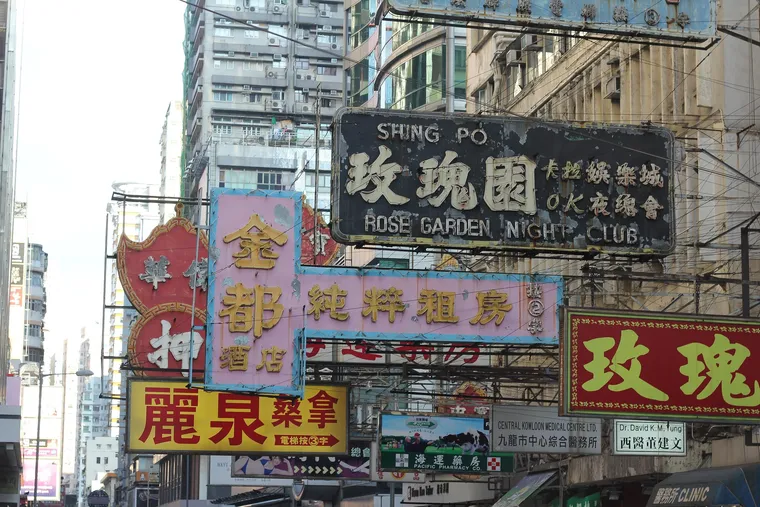
What is a crypto shop in Hong Kong?
A crypto shop, or 加密貨幣找換店, is a walk-in counter where staff quote you a price and swap Hong Kong dollars in cash for Bitcoin, Ether and other coins, or the other way round. Think of it as halfway between a money changer and an exchange. In February 2024 the Financial Services and the Treasury Bureau estimated, from preliminary site observations by law enforcement, that Hong Kong had about 200 physical virtual-asset OTC outlets (ATMs included) plus roughly 250 online platforms or active posts. In April 2025 legislator Duncan Chiu put the number at “over 200”, all unlicensed, adding that anyone with a business registration could open one.
They cluster tightly. In February 2025 Wen Wei Po counted about 15 crypto shops and three ATMs on a single floor of a Mong Kok commercial building, which from the description is W Plaza at 608 Nathan Road. Chungking Mansions in Tsim Sha Tsui, Causeway Bay, Hoi Yuen Road in Kwun Tong and Admiralty Centre are the other main bases. The New Territories have only a handful of branches, in Yuen Long, Sheung Shui, Sha Tin and Tsuen Wan.
Compared with a Bitcoin ATM, a shop has a person you can ask and haggle with, and on larger trades it usually costs far less than an ATM’s 13%. Compared with a licensed OTC desk, it takes cash and small tickets, but nobody at the SFC is supervising it.
Crypto shops in Hong Kong by district
All 20 counters below come from the operators’ own websites as of 6 October 2026. We did not visit them, and addresses are written as each operator publishes them. Names that crop up on older online lists, such as Rice, COINGAROO, Coinfactory, Crypto Master and BitAny, are left out because no operator page gives a current street address. One Satoshi’s Shek Mun branch was on its list at the end of September and gone by October, so treat it as closed or moved.
Kowloon
Kowloon has the densest cluster. All four brands are in Mong Kok, where VBIT’s Argyle Street branch opens at 9:30am, the earliest of any shop we verified, and PP Crypto in Prince Edward says it has been trading since 2017. Tsim Sha Tsui adds One Satoshi in Chungking Mansions and its reservation-only K11 Atelier desk. Hoi Yuen Road in Kwun Tong has One Satoshi and VBIT a short walk apart. We review the main brands in detail: One Satoshi, VBIT and Crypto HK.
Hong Kong Island
On the island, shops sit mainly in Causeway Bay and Admiralty. On Canal Road East, One Satoshi’s weekday office is a few doors from COINHERO’s flagship, which has a 24-hour two-way ATM and also runs COINHERO OTC (minimum HK$8,000, fee up to 5%, 3% for members). Admiralty Centre is Crypto HK’s home base, and its 24-hour centre only serves pre-registered clients. Sheung Wan is the traditional money-changer district, but we could not confirm a single crypto shop there on any operator page.
New Territories
Choice thins out sharply in the New Territories. Tuen Mun, Tai Po, Tseung Kwan O and Tung Chung have no verified shop, so people who need a cash trade usually head to Yuen Long, Tsuen Wan or Sheung Shui. The Sheung Shui branch is close to the Lo Wu and Lok Ma Chau crossings and gets heavy cross-border shopper traffic at weekends.
Are crypto shops legal? Their status in 2026
A shopfront and a signboard don’t mean a business is regulated. As of 6 October 2026 no crypto shop in Hong Kong holds an SFC virtual asset licence. The SFC has licensed 13 virtual asset trading platforms, all of them online and all funded by bank transfer, never cash. A shop that also changes foreign currency or remits money needs a Money Service Operator (MSO) licence from Customs, and running without one carries up to a HK$1 million fine and two years in prison. But an MSO licence covers fiat exchange and remittance only; it is not permission to deal in crypto. One Satoshi has been reported by third parties to hold an MSO licence; we could not confirm that in official records.
Two changes are squeezing the shops. The first is the Stablecoins Ordinance (Cap. 656), in force since 1 August 2025. Answering a Legislative Council question on 10 September 2025, the government said OTC shops are not permitted offerors and cannot offer specified stablecoins such as USDT to retail or professional investors, and that the HKMA would follow up. Media reported some Admiralty shops pausing USDT or closing, and VBIT now accepts USDT only when customers sell it to the shop.
The second is the virtual asset dealer regime. On 24 December 2025 the FSTB and the SFC concluded that converting crypto and fiat through physical locations will need an SFC licence, with HK$5 million in paid-up capital, competence exams, blockchain analytics and client assets held by a licensed custodian. Crucially, there is no transitional period: unlicensed shops must stop on the day the law starts. The government says the bill will come in 2026; as of 6 October 2026 it had not been introduced. Genuine person-to-person trades with no intermediary are outside the scope.
Crypto shops are in their last grey period. Once the dealer regime starts, most one-room shops will struggle to meet a HK$5 million capital requirement.
Using one today isn’t illegal for the buyer. But if you hand a shop a meaningful part of your savings, accept that if it goes wrong there is no SFC, no compensation fund, only a police report.
How a crypto shop trade works
Say you want Bitcoin. You go to the counter, ask for a quote, and staff give you a unit price for your amount. Above the shop’s threshold they ask for HKID or a passport. You give them a receiving address from your own wallet, hand over cash, and they send the coins from the shop’s wallet. Your job is to stay until the coins show up in your wallet. Selling is the reverse: you send coins to the shop’s address, they wait for confirmations, then count out cash.

Unlike licensed platforms, shops don’t publish fee tables. The cost sits in the gap between their buy and sell prices. One older snapshot showed a shop buying USDT for cash at 7.487 and selling at 7.932, a round trip of about 5.8%, but that is a single quote, and nobody publishes systematic spread data. COINHERO’s OTC counter is one of the few that states its terms: minimum HK$8,000, up to 5% (3% for members), and ID checks above HK$100,000.
Picture a Kwun Tong office worker paid into HSBC who wants HK$3,000 of Bitcoin to try it out. A Hoi Yuen Road counter is a poor fit at that size. Paying the cash into the bank and funding a licensed platform by FPS costs a few dollars. Shops make most sense for someone who already holds crypto and needs cash, or who genuinely can’t use a bank account, and even then large amounts of cash carry real safety risk.
ID thresholds compared
“Shops don’t ask for ID” is a common line, but thresholds vary a lot and are shifting as the rules tighten. The table uses what each operator publishes. No published number doesn’t mean no questions: VBIT says it follows AML and know-your-customer rules but gives no figure.
| Shop | ID or appointment threshold | Payment | Other terms |
|---|---|---|---|
| One Satoshi | No ID at or below HK$120,000; above that HKID or passport, possibly 2-month address proof | Cash only | Older guides said HK$80,000; the operator now says HK$120,000 |
| Crypto HK | Cash sales under HK$100,000 without appointment; above that by WhatsApp or Telegram booking | Cash buys in HKD, CNY or USD | Bank-transfer sales from HK$500,000 |
| PP Crypto | Appointment above HK$50,000 | Not stated | Tsuen Wan by appointment only |
| VBIT | No figure; says it follows AML rules | Not stated | USDT only bought from customers |
| COINHERO OTC | ID checks above HK$100,000 | Not stated | Minimum HK$8,000; up to 5%, members 3% |
Source: operator websites, checked 6 October 2026.
Reality is messier than the table. Wen Wei Po’s 2025 investigation found about half the shops in that Mong Kok building asked for no identification at all, and one staffer reportedly described non-real-name wallets as “discreet”. Wu Blockchain reported in May 2025 that some shops demand real names and source-of-funds statements, while most only want a payment QR code and a wallet address. For a buyer, “no ID needed” is a warning sign rather than a perk. A shop that doesn’t ask where money comes from may also have taken dirty money, and your trade can get pulled into a police investigation.
Fake shops, scams and robberies
The cases below are dated and were all reported by the media. Several older stories show up in search engines wrongly dated to 2026, such as the search of a JPEX-linked shop (actually October 2023) and a foreigner losing HK$72 million (March 2025). We use the real dates.
- May 2024Tsim Sha Tsui: hell money for USDT
A customer sent about HK$1 million in USDT and was handed hell banknotes; three shop staff were arrested.
- Jan–Sep 2024West Kowloon: fake crypto shops
13 investors lost HK$14.8 million at fake “crypto exchange stores”; one businessman was locked inside on his third deal.
- 17 Apr 2025Kwun Tong: cash handed over, no coins
A victim brought HK$1 million in cash to an upstairs shop for USDT; the shop said the coins never arrived and a third party took the cash.
- May 2025Laundering ring used TST shops
Police broke a HK$118 million ring that used 500-plus stooge accounts and converted the cash into crypto at Tsim Sha Tsui exchange shops; 12 arrested.
- 13 Dec 2025Mong Kok, W Plaza: knife attack
A crypto shop owner and his wife were attacked by men with knives at closing time; nothing was taken.
- 30 Jan 2026Sheung Wan robbery, TST shop staff arrested
After a yen robbery on Des Voeux Road Central, two staff of a Tsim Sha Tsui virtual-currency shop were arrested for allegedly handling the loot.
- 6 Mar 2026Sheung Wan Exit B: about HK$10 million
A knife robbery after a money-changer deal; police lying in wait arrested three. It was the third similar case in Sheung Wan in three months.
- Jun 2026Fake OTC dealer takes 1.6m USDT
A man lost about HK$14 million in USDT to a fake over-the-counter dealer.
The pattern repeats: large amounts of cash, upstairs units or unsigned “offices”, dealers contacted through social media or messaging apps, and “pay first, receive later” arrangements. Across 2025, police recorded 5,135 online investment fraud cases with HK$3.58 billion lost, about a third involving virtual assets. More on spotting them in scams and licence checks.
Checklist before you go
If a trade goes wrong, report it to the police straight away, keep the evidence and call the 18222 Anti-Scam Helpline. For routes that don’t involve carrying cash, compare SFC-licensed platforms or the bank routes in our cash-out guide. The rules are set out in the government’s LegCo reply and on the Customs MSO page.
Frequently asked questions
Are crypto shops legal in Hong Kong?
They operate in a grey zone. Nothing bans them, but none holds an SFC virtual asset licence, and any currency exchange or remittance they do needs a Money Service Operator licence from Customs. The government has decided to bring them under an SFC dealer licence with no transitional period; as of 6 October 2026 the bill had not reached the Legislative Council.
Do crypto shops ask for ID?
It varies. One Satoshi says no ID is needed at or below HK$120,000, with HKID or passport (and possibly recent address proof) above that. Crypto HK wants an appointment for cash sales of HK$100,000 or more, and PP Crypto above HK$50,000. A 2025 Wen Wei Po investigation found about half the shops in one Mong Kok building did no checks at all.
Can I still buy USDT at a crypto shop?
Not legally from the shop’s side. Since the Stablecoins Ordinance took effect on 1 August 2025, the government has said OTC shops are not permitted offerors and cannot offer specified stablecoins such as USDT to the public. Some stopped quoting it; VBIT now only buys USDT from customers. For legal routes see USDT to HKD.
What changes when the VA dealer licence starts?
Shops will need an SFC dealer licence from day one, with no deemed-licence period. The proposals include HK$5 million paid-up capital, competence exams, blockchain analytics and client assets held with a licensed custodian. Most one-room shops are unlikely to meet that, so expect closures and consolidation into a few larger chains.
Is One Satoshi legit?
One Satoshi is the largest walk-in chain, with nine locations on its own store list, and we found no fraud ruling or official warning against it. Like every crypto shop, though, it is not SFC-licensed, so there is no investor compensation if something goes wrong. See our One Satoshi review.
Sources
- One Satoshi — stores and FAQ · checked 6 Oct 2026
- VBIT — branches and services · checked 6 Oct 2026
- Crypto HK — contact and branches · checked 6 Oct 2026
- LCQ10: stablecoins and OTC shops (government press release) · 10 Sep 2025
- HKSAR Government — conclusions on regulating VA dealing and custody · 24 Dec 2025
- Customs and Excise Department — Money Service Operators · Oct 2026
Ready for your first coin?
Sign-up and the ID check take a few minutes. Then buy Bitcoin, Ether or USDT with Visa, Mastercard or Apple Pay.
It is not licensed by Hong Kong’s SFC, so local investor protection does not apply. For HKD and FPS deposits, use a licensed platform.