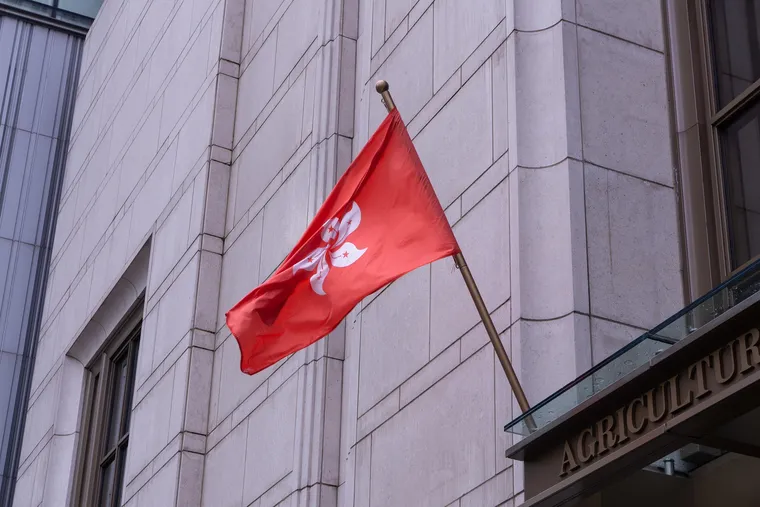
The short answer: crypto is legal in Hong Kong, platforms need a licence
Is crypto legal in Hong Kong? Yes. Individuals can buy, hold and sell crypto without breaking any law. Unlike mainland China, Hong Kong has never banned virtual asset trading; instead the government has published two policy statements, in 2022 and 2025, saying it wants the city to be a regulated hub for digital assets.
Legal does not mean unregulated, though. Hong Kong regulates the middlemen rather than the buyer. Trading platforms, the coming OTC dealers and custodians, and stablecoin issuers all need licences. Your own job as a buyer is mostly to pick a licensed platform, keep records, and never let anyone route money through your bank account. Crypto is also not money in the legal sense. In January 2014 the then Secretary for Financial Services and the Treasury told LegCo that Bitcoin is not legal tender but a “virtual commodity”. Nothing has changed since: the Hong Kong dollar remains the only legal tender.
Who regulates what: six agencies
People often assume the SFC handles everything. In practice the rules are split across several bodies, and knowing who does what is useful: scams go to the police, platform problems to the SFC, tax questions to the IRD, and carrying a bag of cash across the border is a customs matter.
| Agency | What it covers | What it means for you |
|---|---|---|
| Securities and Futures Commission (SFC) | Licensing trading platforms, brokers’ crypto business, ETF authorisation, the suspicious-platform Alert List | Trade only on listed platforms; check the list before signing up |
| Hong Kong Monetary Authority (HKMA) | Banks’ crypto activities, stablecoin issuer licences, e-HKD and Project Ensemble | Bank-app crypto and HKD stablecoins sit under it |
| Financial Services and the Treasury Bureau (FSTB) | Policy and legislation, including policy statements and the dealing/custody bill | Sets the direction of new rules |
| Customs and Excise Department (C&ED) | Money service operator (MSO) licences; cross-boundary cash declarations | Shops exchanging cash or remitting need an MSO licence; declare over HK$120,000 at the border |
| Inland Revenue Department (IRD) | Profits and salaries tax; CARF reporting from 2027 | Trading as a business is taxable |
| Police and the Joint Financial Intelligence Unit (JFIU) | Fraud and money-laundering investigations, suspicious transaction reports | Report scams; never rent out your account |
The JFIU’s figures show how closely money is watched: it received a record 190,636 suspicious transaction reports in 2025. Banks and licensed firms flag unusual flows, which is exactly why taking an unexplained payment from a P2P stranger can get your bank account frozen.
AMLO Part 5B: how platform licensing works
The core of Hong Kong crypto regulation is Part 5B of the Anti-Money Laundering and Counter-Terrorist Financing Ordinance (Cap. 615). Since 1 June 2023, anyone operating a virtual asset trading platform in Hong Kong, or actively marketing one to the Hong Kong public, must be licensed by the SFC. Running an unlicensed platform is a criminal offence punishable by fines and imprisonment.
There was a transition. Platforms already operating before 1 June 2023 could keep going as “deemed-to-be-licensed” if they applied by 29 February 2024. Those that didn’t apply had to close their Hong Kong business by 31 May 2024, and the transitional period ended on 1 June 2024. A few deemed applicants are still on the SFC’s list, including Crypto.com’s Foris DAX HK, but the SFC is explicit that they are not formally licensed. Sixteen other applications, including OKX, Huobi HK, Gate.HK and BitMart, were withdrawn or returned.
What protects retail buyers on a licensed platform
Licensed platforms follow the SFC’s Guidelines for Virtual Asset Trading Platform Operators. Four rules matter most to a buyer. Client assets are held on trust by an associated entity, mostly in cold storage. Retail clients can only buy “eligible large-cap” tokens that appear in at least two indices from two independent providers, which is why licensed platforms list a handful of coins while offshore exchanges list hundreds. You go through a knowledge and risk assessment and get an exposure limit. And the platform cannot dangle gifts to make you trade.
Some rules loosened in November 2025: HKMA-licensed stablecoins can now be offered straight to retail clients, and platforms can distribute tokenised securities and related products. Professional investors, meaning individuals with a portfolio of at least HK$8 million, get a wider token list and, under a framework published on 11 February 2026, access to perpetual contracts that retail clients cannot touch. For every licensee and its CE number, see the SFC-licensed platforms list.

Bitcoin, trading and mining: is each one legal?
Is Bitcoin legal in Hong Kong?
Yes. You can hold Bitcoin through a licensed platform, a bank or broker app, a Bitcoin ATM, or one of the spot Bitcoin ETFs listed on HKEX. The difference between those routes is cost and protection, not legality. Our Bitcoin buying guide compares them.
Is crypto trading legal, even frequent trading?
Yes, with two consequences to keep in mind. The first is tax. Hong Kong has no capital gains tax, but if your trading is frequent and organised, the IRD may treat it as a business and charge profits tax; our crypto tax guide explains where the line sits. The second is derivatives. Retail clients cannot trade perpetual contracts on licensed platforms; the only regulated way to get futures exposure is through the SFC-authorised crypto futures ETFs on HKEX, bought in an ordinary securities account.
Is crypto mining legal in Hong Kong?
No law prohibits it; mining is an ordinary business activity subject to your lease, fire-safety rules and electricity supply terms. The problem is the bill. Average net tariffs for 2026 are about 140.6 cents per kWh at CLP and 163.3 cents at HK Electric, roughly HK$1.41 to HK$1.63 a unit and several times what large miners pay elsewhere. Add cooling, noise and Hong Kong rents, and a home rig is very unlikely to break even. In September 2025, two technicians were reportedly arrested for hiding eight rigs in the ceilings of care-home offices in Sham Shui Po and Sau Mau Ping, and charged with abstracting electricity. Mining is legal; stealing the power is not. “Cloud mining” investment schemes, meanwhile, are a common scam.
Offshore exchanges: legal to use, but at what cost?
Hong Kong doesn’t block offshore exchanges, and it isn’t an offence for a resident to open an account with one. The law targets the platforms: an unlicensed exchange cannot operate in Hong Kong or actively market to Hong Kong investors. That is why many have shut Hong Kong out themselves. OKX lists Hong Kong as a “Restricted Location” in its disclosure updated 8 July 2026, and KuCoin, Gate and MEXC do likewise. Bybit has been on the SFC Alert List since 14 March 2024, and MEXC is on it too.
Some international platforms still accept Hong Kong residents; CEX.IO and Kraken, for example, don’t list Hong Kong as unsupported. The trade-off is plain. There is no SFC supervision, no Hong Kong investor compensation, any dispute is handled under the platform’s home law, and there is usually no HKD or FPS funding.
Timeline of Hong Kong crypto regulation
In a few years Hong Kong moved from professional-investor-only crypto to open retail access, then on to stablecoins and OTC dealing. These are the milestones that changed things for buyers:
- 8 Jan 2014LegCo reply: Bitcoin is a “virtual commodity”
Not legal tender; no plan to ban it.
- 31 Oct 2022First policy statement on virtual assets
“Same activity, same risks, same regulation”; licensing and retail access promised.
- 1 Jun 2023Platform licensing takes effect
AMLO Part 5B; licensed platforms may serve retail.
- 30 Apr 2024Asia’s first spot Bitcoin and Ether ETFs list
Six funds from ChinaAMC, Harvest and Bosera HashKey.
- 1 Jun 2024Transitional period ends
Platforms that never applied must have left Hong Kong.
- 19 Feb 2025SFC publishes the ASPIRe roadmap
Five pillars, 12 initiatives incl. OTC and custody licensing, staking, derivatives.
- 26 Jun 2025Policy Statement 2.0 (LEAP)
Legal streamlining, Expanding tokenised products, Advancing use cases, People and partnerships.
- 1 Aug 2025Stablecoins Ordinance (Cap. 656) in force
Only HKMA-licensed issuers’ coins may be offered to retail.
- 24 Dec 2025Dealing and custody consultation conclusions
OTC dealers to be SFC-licensed, with no transitional period.
- 10 Apr 2026First two stablecoin issuer licences
HSBC and Anchorpoint Financial.
- 16 Sep 2026Policy Address
Licensed stablecoins to trade on licensed platforms; tokenised gold and other real-world assets.
- Within 2026 (pending)Dealing, custody, advisory and management bill
Not gazetted or introduced to LegCo as of 6 Oct 2026.
The 2022 statement set the principle. Policy Statement 2.0 in June 2025 added the LEAP framework: streamlining the legal and regulatory set-up, expanding tokenised products, advancing real-world use cases, and building people and partnerships. The SFC’s ASPIRe roadmap from February 2025 is the working to-do list behind it, and it has steadily delivered: staking on licensed platforms (April 2025), shared order books with affiliated overseas platforms (November 2025) and broker margin financing for crypto (February 2026). The 16 September 2026 Policy Address went further, promising to promote trading of licensed stablecoins on licensed platforms, using them to settle tokenised money market funds, and setting up an SFC “Digital Asset Accelerator” in 2026-27.
The grey zone: walk-in shops, ATMs and P2P
There is still one patch of Hong Kong’s crypto market that sits outside the licensing net. As of October 2026, walk-in crypto exchange shops and Bitcoin ATMs hold no virtual asset licence of any kind. The government has estimated around 200 physical OTC shops and some 250 online dealers. A shop that also changes currency or remits money needs a money service operator licence from Customs, but a plain cash-for-coins trade falls outside that regime.
The gap is closing. The 24 December 2025 consultation conclusions confirmed that virtual asset dealers, including OTC shops, will be licensed by the SFC, with a proposed HK$5 million paid-up capital and no transitional period: on day one, unlicensed shops must stop. The Policy Address supplement commits to introducing the bill to LegCo within 2026, but as of 6 October 2026 it has not been gazetted. Separately, since the Stablecoins Ordinance took effect the government has told LegCo that OTC shops are not “permitted offerors” and may not offer stablecoins such as USDT. Read our crypto shop guide before you walk into one.
In Hong Kong the question was never whether buying crypto is legal. It is how much protection you are willing to trade for convenience.
Licensed platforms list fewer coins and make you sit a knowledge test, but the SFC and the custody rules stand behind them. Offshore apps and walk-in shops are easier, and if something goes wrong, Hong Kong rules won’t help you. Our view: open one licensed account as your main HKD on- and off-ramp, and treat everything else as a supplement.
The rules are moving quickly, and we update this page when the dealer bill is gazetted, a new platform is licensed or an HKD stablecoin goes live. For stablecoin specifics, read our Stablecoins Ordinance guide; to check a platform yourself, start with the SFC’s suspicious platform Alert List and our licence-check walkthrough.
Frequently asked questions
Is crypto legal in Hong Kong?
Yes. No Hong Kong law stops an individual from buying, holding or selling Bitcoin or other crypto. What is regulated is the business side: since 1 June 2023, anyone running a virtual asset trading platform in Hong Kong, or actively marketing one to Hong Kong investors, needs an SFC licence. As of October 2026 there are 13 licensed platforms; see the full SFC list.
Is Bitcoin legal tender in Hong Kong?
No. The Hong Kong dollar is the only legal tender. In January 2014 the government told the Legislative Council that Bitcoin is not legal tender but a “virtual commodity”, and that position still stands. Shops may choose to accept crypto, but nobody is obliged to, and it cannot be used to settle a legal debt.
Is crypto mining legal in Hong Kong?
Mining is not prohibited, but it almost never pays. Average 2026 tariffs are about 140.6 cents per kWh at CLP and 163.3 cents at HK Electric, several times what industrial miners pay elsewhere. The mining is legal; stealing power to run rigs is not, as two technicians charged with abstracting electricity in September 2025 found out.
Is it illegal to use an offshore exchange from Hong Kong?
Opening an account is not an offence for the user, and Hong Kong does not block these sites. But unlicensed platforms may not market to Hong Kong investors, and you get no local protection if something goes wrong. OKX, Bybit and KuCoin restrict Hong Kong users in their own terms, and Bybit and MEXC are on the SFC Alert List. See our scam and licence-check guide.
Which coins can retail investors buy on licensed platforms?
Only “eligible large-cap” virtual assets, meaning tokens included in at least two indices from two independent index providers. As of October 2026, OSL offers retail clients BTC, ETH, SOL and XRP, and Tiger’s YAX offers BTC, ETH, SOL, AVAX and LINK. You also pass a knowledge assessment and get an exposure limit when you open the account.
Sources
- SFC — Lists of virtual asset trading platforms · checked 6 Oct 2026 (list updated 29 May 2026)
- LCQ1: Monitoring the use of bitcoins (SFST reply) · 8 Jan 2014
- Policy Statement 2.0 on the Development of Digital Assets in Hong Kong · 26 Jun 2025
- SFC — ASPIRe regulatory roadmap · 19 Feb 2025
- FSTB/SFC — VA dealing and custodian consultation conclusions · 24 Dec 2025
- Policy Address 2026 — Supplement, Chapter 3 · 16 Sep 2026
Ready for your first coin?
Sign-up and the ID check take a few minutes. Then buy Bitcoin, Ether or USDT with Visa, Mastercard or Apple Pay.
It is not licensed by Hong Kong’s SFC, so local investor protection does not apply. For HKD and FPS deposits, use a licensed platform.